
27 October 2025
Majority of Europeans polled want rules to limit new data centres’ impacts on energy, water and economy
People see untethered data centre growth as a threat to Europe’s energy and water security, and want Big Tech to be regulated – new poll reveals
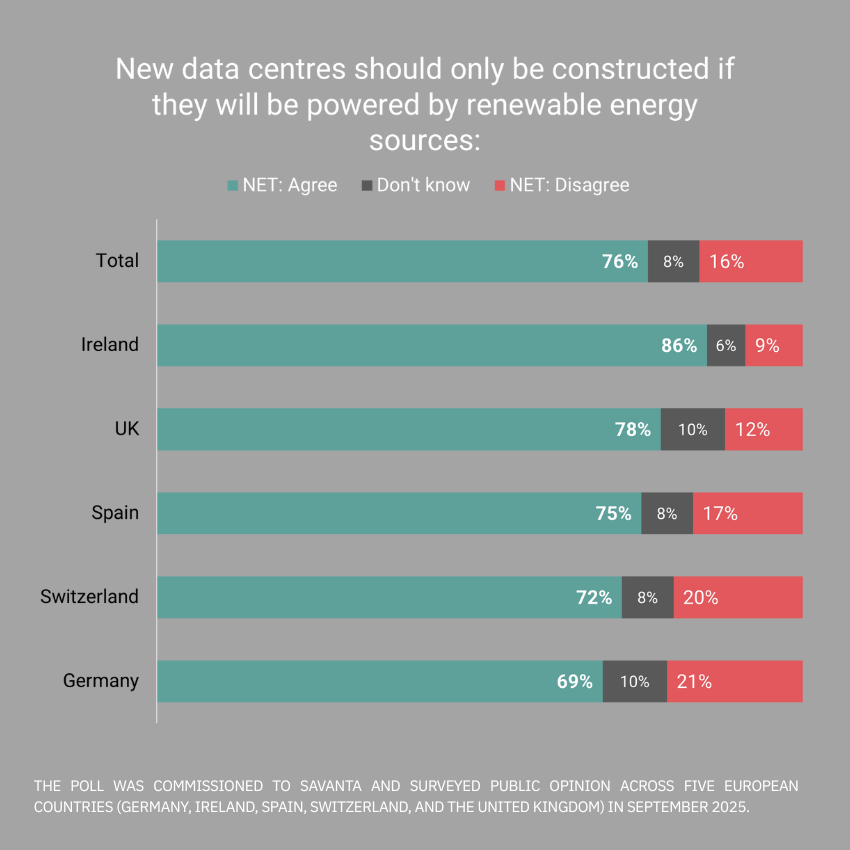
Berlin, 27 October 2025 – A staggering majority of respondents in a polling commissioned by Beyond Fossil Fuels and conducted by Savanta in five European countries do not want new data centres (DCs) to jeopardise Europe’s clean energy transition, drain water resources and raise costs for consumers. Respondents also expressed concern about data centres rising energy consumption.[1]
The results show broad opposition to fuelling data centres with fossil energy, and strong support for powering new ones with renewables:
- Majorities across all markets and demographics support mandating new data centres be built only if new renewable energy sources are created in order to power them (72%);
- Two-thirds (64%) think data centres should not be built if they are powered with fossil fuels;
- 76% think that new data centre facilities should be built only if powered by renewable energy;
- 73% think governments should put clear criteria in place to ensure energy distribution (in other words how priority access to electricity for different sectors and uses is determined).
Jill McArdle, International Corporate Campaigner, Beyond Fossil Fuels, said: “This is a wake up call for policymakers in Europe racing ahead with data centre expansion at all costs. Instead of cheering at this unchecked growth, people are sounding the alarm: unregulated data centres risk stalling the energy transition, draining water resources and sending energy costs skyrocketing.”
“Their message to European leaders is clear: new data centres must not run on fossil fuels. People want to see them powered by renewables, or not built at all. But that’s not all, they do not want data centres jumping the queue for access to energy, ahead of households, public services and the electrification of European industries. It is time for Europe to stop pandering to Big Tech and start regulating data centres.”
As data centre growth explodes, it is putting pressure on energy access, particularly renewable energy, for other sectors. The poll’s results show that people want leadership from governments to make sure new data centres energy demand does not compete with broader electrification efforts. Three in four respondents want leaders to set clear criteria for how energy is distributed between sectors, and show strong appetite for policy-led solutions to ensure fairer energy access, in particular at times of energy and water shortages, as those experienced in parts of Europe last summer.
When asked to prioritise energy access across nine sectors in the event of energy or water shortages, respondents consistently ranked data centres at the bottom. Public services including healthcare, housing, and food were seen as far more important. Only 4% of people listed data centres as a first priority in the event of energy shortages, and only 3% listed them as first priority in the event of water shortages.
Respondents expressed strong concerns about data centres’ water demand, with 69% worried about data centres impacting their own water supply. Even more people (75%) are concerned about data centres impacting water supply of their surrounding ecosystem.
Aurora Gómez Delgado, coordinator of Tu Nube Seca Mi Río, said:
“Water is essential for life; cat memes are not. Spain is a region suffering from severe droughts and deadly floods due to the climate emergency, and people are rightly concerned about the water consumption of data centres.”“Thirsty data centres, set up in desert areas, are an example of digital colonialism: they steal our data, and hide their impacts on our bodies and our lands. Big Tech might expect our silence and gratitude, instead they got our resistance to an industry which is taking away our land, our water and the energy we need for our livelihoods”.
A strong majority, 83% of the respondents agreed that data centres must contribute more than households and small businesses towards energy costs.
A similar number of respondents, 83%, also believe that data centres must contribute financially into the energy grid, of which 64% thought it should be through taxes on energy use or on profits, or higher tariffs.
Rosi Leonard, Network Development Coordinator and Data Centre Campaign Lead, Friends of the Earth Ireland, said:
“It’s clear that people want to see housing and public services prioritised for access to clean energy. Crucially, people recognise that Big Tech companies who have done the most to max out the grid to breaking point should bear more financial responsibility towards fixing it. If the Irish Government chooses to grasp the nettle and put the brakes on Big Tech’s power grab, clearly they will have the support of the public behind them.”
A significant 85% of respondents also want data centres to disclose their environmental impacts, energy usage (83%), and energy sourcing (83%).
Nearly four in five agree that tech companies should reveal which data centres they are leasing (77%), and for which services they use (78%), with scant opposition or uncertainty.
Dr. Julian Bothe, Senior Policy Manager for AI and Climate Protection at AlgorithmWatch – Germany, said:
“The public clearly sees the dangers posed by the unregulated expansion of data centres, which is largely driven by a push for more Artificial Intelligence. The additional power demand of data centers jeopardizes climate protection and prolongs the dependency on fossil fuels. It also causes electricity prices to rise — at the expense of the population and other businesses. Big Tech makes Billions, Ben and Berta get the bill. Data centers and AI applications must finally disclose verifiable data about their electricity consumption. The rule must be simple: no new data centers without additional renewable energy sources. Otherwise, AI expansion will make our climate targets impossible to reach.”
Chris Adams, Director of Technology and Policy at the Green Web Foundation, said:
“Right now, when we treat all data centres like critical infrastructure, regardless of what they’re used for, we’re effectively saying serving ads is as important to society as keeping people alive in hospitals. That’s obviously ridiculous, and these results show that the public thinks so too. Not all demand for power is equal, even if it’s coming from clean sources.”
Policymakers must regulate data centre energy demand, and Big Tech must be held accountable to ensure their data centres are powered by new, additional renewables, without jumping the queue ahead of public services and decarbonising sectors. Otherwise, the data centre boom risks pushing energy use and costs to unsustainable levels.
END
____________________________
CONTACTS
Jill McArdle, International Corporate Campaigner, Beyond Fossil Fuels, [email protected], mobile +32 456 723 993
Pierre Terras, Corporate Programme Lead, Beyond Fossil Fuels, [email protected] , mobile +33 646 90 21 04
NOTES
[1] The ‘Data Centre Energy polling’ — commissioned by Beyond Fossil Fuels in cooperation with Algorithm Watch Germany, Algorithm Watch Switzerland, Friends of the Earth Ireland, TuNubeSecaMiRio, Global Action Plan and the Green Web Foundation, was conducted by Savanta in Germany, Ireland, Spain, Switzerland and the United Kingdom between 11 and 30 September 2025.
The respondents were formed of nationally representative samples per age, gender, region, in five European countries: Ireland (1001), the United Kingdom (1001), Spain (1022), Germany (1002) and Switzerland (1006). A total of 5032 individuals participated in the survey, all aged +18, 51% women, 49% men.
Key findings and more information from the poll can be found in the following Executive Summary, Beyond Fossil Fuels, October 2025.
ADDITIONAL QUOTES FROM PARTNERS
Dr. Angela Müller, Executive Director of AlgorithmWatch Switzerland, said: “AI does not fall from the sky – or the ‘cloud’. Rather, massive amounts of human work, water, and energy are needed to develop and use AI. At the same time, Tech CEOs call for bigger AI everywhere – and for access to all kinds of energy sources. Our poll shows that people in Switzerland are really concerned about the growing resource consumption of data centers as a crucial part of the AI infrastructure: they want to know how much energy and water is being consumed behind the thick grey walls of data centers and AI companies. They also want data centers to be powered by renewable energy sources. This sends a clear message to decision makers: tech and climate governance must go hand in hand.“
Oliver Hayes, Head of Policy & Campaigns, Global Action Plan UK, said:
“It’s no coincidence that Big Tech’s imposition of data centres has been most aggressive where public awareness is lowest. But when confronted with the stark reality, UK citizens clearly grasp what their Government won’t: data centres deliver private gain for public pain.
“The UK is a nation of climate advocates who know greenwash when they see it. Ministers who think they can quietly heed Big Tech’s demands for priority access to energy and water in service of chatbots and AI slop are in for a shock.
“This polling couldn’t be clearer: the public expect Big Tech to pay for new renewables and grid upgrades, and for their activities to be in service of, not jeopardising, critical industries like housing and healthcare.”
BACKGROUND
Europe is in the middle of a data centre boom. The EU and European governments intend to drastically increase data centre capacity. The EU’s AI Continent Strategy in particular includes plans to triple the EU’s data centre capacity within the next five to seven years to support cloud and especially AI services.
This exponential data centre growth is leading to a surge in power demand, potentially posing a serious risk of escalating emissions—either through expanded gas infrastructure or by pushing other sectors onto fossil fuels as new data centres capture new renewable energy, as Beyond Fossil Fuels highlighted in SYSTEM OVERLOAD: How New Data Centres Could Throw Europe’s Energy Transition Off Course, February 2025. Meanwhile, grassroots public opposition to new data centres is mounting in Europe and beyond.
Recent moves from Big Tech and data centre expansion have been particularly alarming when it comes to fossil fuels. Big tech companies have drastically increased their emissions in the context of the AI boom with extremely worrying developments in the US. However, in Europe too data centres in countries like Ireland, Germany, the UK, Greece and Italy are now trying to power their energy needs with on-site fossil gas generation or directly from the gas grid. In the US, recent analysis shows a link between high concentrations of DCs and increased energy bills for local residents.
About Beyond Fossil Fuels
Beyond Fossil Fuels is a civil society network committed to ensuring a just and rapid transition to a fossil-free, renewables-based future. Building upon the Europe Beyond Coal campaign, its goal is for Europe to be coal-free by 2030 and phase out fossil gas from the power sector by 2035. A clean and flexible energy system will deliver lasting benefits for people, the climate and the broader economy. Beyond Fossil Fuels is a non-profit organisation with an office in Berlin, with staff spread across Europe.